Choosing the best flooring for kitchen in 2026 requires balancing durability, water resistance, and aesthetics. With over 67% of United States homeowners prioritizing waterproof flooring for kitchen spaces during renovations, the market has evolved significantly. This comprehensive guide examines vinyl, tile, and laminate options to help you select the most suitable kitchen flooring based on your lifestyle, budget, and design preferences.
What is the Current Trend in Kitchen Flooring?
The current trend in kitchen flooring for 2026 emphasizes luxury vinyl plank (LVP) and large-format porcelain tiles. According to the National Kitchen & Bath Association, 58% of United States kitchen remodels now incorporate waterproof vinyl flooring due to its realistic wood and stone appearances. These materials combine advanced water resistance with contemporary aesthetics, offering homeowners practical beauty that withstands daily kitchen activities.
Large-format tiles measuring 12×24 inches or larger dominate design preferences, creating fewer grout lines and streamlined appearances. The shift toward lighter flooring options continues, with warm gray, beige, and whitewashed finishes comprising 71% of kitchen flooring installations across United States homes. Engineered hardwood alternatives have gained traction among homeowners seeking traditional wood aesthetics with enhanced moisture protection for transitional spaces between kitchen and living room areas.
Most Durable Kitchen Flooring Options
Durability remains the paramount consideration when selecting kitchen flooring, as this high-traffic area endures constant foot traffic, spills, and dropped objects. The most durable kitchen flooring materials in 2026 include porcelain tile, luxury vinyl, and natural stone, each offering distinct longevity characteristics suited to different household needs.
Porcelain Tile: Premium Durability Champion
Porcelain tiles represent the gold standard for kitchen durability, with properly installed floors lasting 50+ years in residential applications. These kitchen tiles achieve Class 5 wear ratings on the PEI scale, indicating suitability for heavy commercial traffic. Porcelain’s imperviousness to water absorption (less than 0.5%) makes it the best waterproof flooring for kitchen environments. Modern manufacturing techniques produce realistic wood-look and marble-effect porcelain tiles that combine aesthetic versatility with uncompromising performance. Installation costs range from $8-15 per square foot in United States markets, reflecting professional labor requirements.
Luxury Vinyl Plank: Modern Resilience
Luxury vinyl plank flooring offers exceptional durability with advanced wear layers ranging from 12-40 mil thickness. Premium LVP products feature rigid core construction that resists denting from dropped cookware and remains dimensionally stable despite temperature fluctuations. These vinyl floors typically last 15-25 years under normal household conditions, with commercial-grade options extending service life beyond 30 years. Enhanced urethane coatings provide scratch resistance superior to traditional sheet vinyl, while 100% waterproof construction prevents subfloor damage from plumbing leaks or spills. United States homeowners appreciate LVP’s $3-8 per square foot price point, which includes DIY-friendly click-lock installation systems.
Best Waterproof Flooring for Kitchen Installations
Water resistance transcends mere preference in kitchen flooring selection—it constitutes an essential requirement. The best waterproof flooring for kitchen spaces protects subfloor integrity, prevents mold growth, and maintains appearance despite inevitable moisture exposure. In 2026, three categories dominate the waterproof kitchen flooring market with proven performance records.
100% Waterproof Vinyl Solutions
Waterproof vinyl flooring technology has advanced considerably, with rigid core formulations (SPC and WPC) offering complete moisture protection from surface to backing. Stone Plastic Composite (SPC) cores contain 60-70% limestone and polymer blends that remain unaffected by standing water for extended periods. Wood Plastic Composite (WPC) alternatives incorporate wood fibers with enhanced cushioning properties while maintaining full waterproof integrity. These vinyl options install successfully over concrete slabs with minor moisture issues, eliminating expensive moisture mitigation procedures. Popular brands like CoreTec, LifeProof, and SmartCore provide 20-30 year residential warranties covering water damage, reflecting manufacturer confidence in waterproof performance.
Ceramic and Porcelain Tile Protection
Kitchen tiles manufactured from ceramic and porcelain materials offer inherent water resistance, though grout line sealing determines overall waterproof effectiveness. Porcelain’s dense composition absorbs less than 0.5% water by volume, earning it impervious classification under ASTM standards. Proper installation with waterproof membranes beneath tile and epoxy grout between tiles creates virtually impenetrable moisture barriers. Rectified-edge porcelain tiles allow tight grout joints (1/16 inch), minimizing maintenance requirements and water penetration risks. United States building codes increasingly specify porcelain tile for kitchens in flood-prone regions, recognizing its superior moisture resistance and dimensional stability.
Should I Put Laminate or Vinyl in the Kitchen?
The decision between laminate or vinyl flooring fundamentally depends on moisture exposure tolerance and budget constraints. While both products simulate hardwood aesthetics convincingly, their performance characteristics differ substantially in kitchen environments where water contact occurs regularly.
Vinyl flooring emerges as the superior choice for kitchens due to its complete waterproof construction, which protects against spills, humidity, and cleaning moisture. Modern luxury vinyl planks maintain structural integrity when exposed to standing water, whereas traditional laminate swells and deteriorates when moisture penetrates core materials. However, water-resistant laminate formulations introduced in 2024-2025 incorporate wax-sealed edges and moisture-resistant HDF cores that withstand brief water exposure, though they cannot match vinyl’s comprehensive waterproof properties. Installation costs favor vinyl at $3-8 per square foot versus laminate’s $2-6 range, but vinyl’s longevity and moisture resistance justify the modest premium for kitchen applications.
Which Floor is Good for Arthritis?
Homeowners with arthritis require kitchen flooring that reduces joint stress while providing stable footing and easy maintenance. The ideal floor for arthritis sufferers combines cushioned resilience with slip resistance and minimal cleaning requirements that accommodate limited mobility.
Luxury vinyl plank with attached padding emerges as the optimal arthritis-friendly kitchen flooring, offering cushioned comfort that reduces impact stress on knees, hips, and ankles during prolonged standing. Cork-backed vinyl products provide additional shock absorption, decreasing joint fatigue by 30-40% compared to rigid tile surfaces according to ergonomic studies. These vinyl floors require simple damp mopping without harsh chemicals or extensive scrubbing that exacerbates hand and wrist arthritis. Slip-resistant textured surfaces prevent falls without creating uneven terrain that challenges balance. United States occupational therapists increasingly recommend cushioned vinyl over hard tile for clients managing arthritis symptoms, noting significant comfort improvements during cooking and cleaning activities.
Best Flooring for Kitchen and Living Room Continuity
Open-concept floor plans demand cohesive flooring selections that transition seamlessly between kitchen and living room spaces. The best flooring for these combined areas balances kitchen-specific requirements like water resistance with living room priorities such as comfort and visual warmth.
Luxury Vinyl Plank Throughout
Installing luxury vinyl plank flooring continuously through kitchen and living spaces creates unified aesthetics while addressing both areas’ functional needs. Wide-plank vinyl mimicking oak, walnut, or hickory provides residential warmth that complements living room furniture arrangements while withstanding kitchen moisture exposure. This approach eliminates transition strips that visually divide spaces and create tripping hazards, particularly important in homes with mobility considerations. Consistent flooring simplifies maintenance routines and typically reduces installation costs by 15-20% compared to using different materials in adjacent rooms. United States interior designers favor this strategy for homes under 2,500 square feet where visual continuity maximizes perceived spaciousness.
Coordinated Tile and Hardwood Transitions
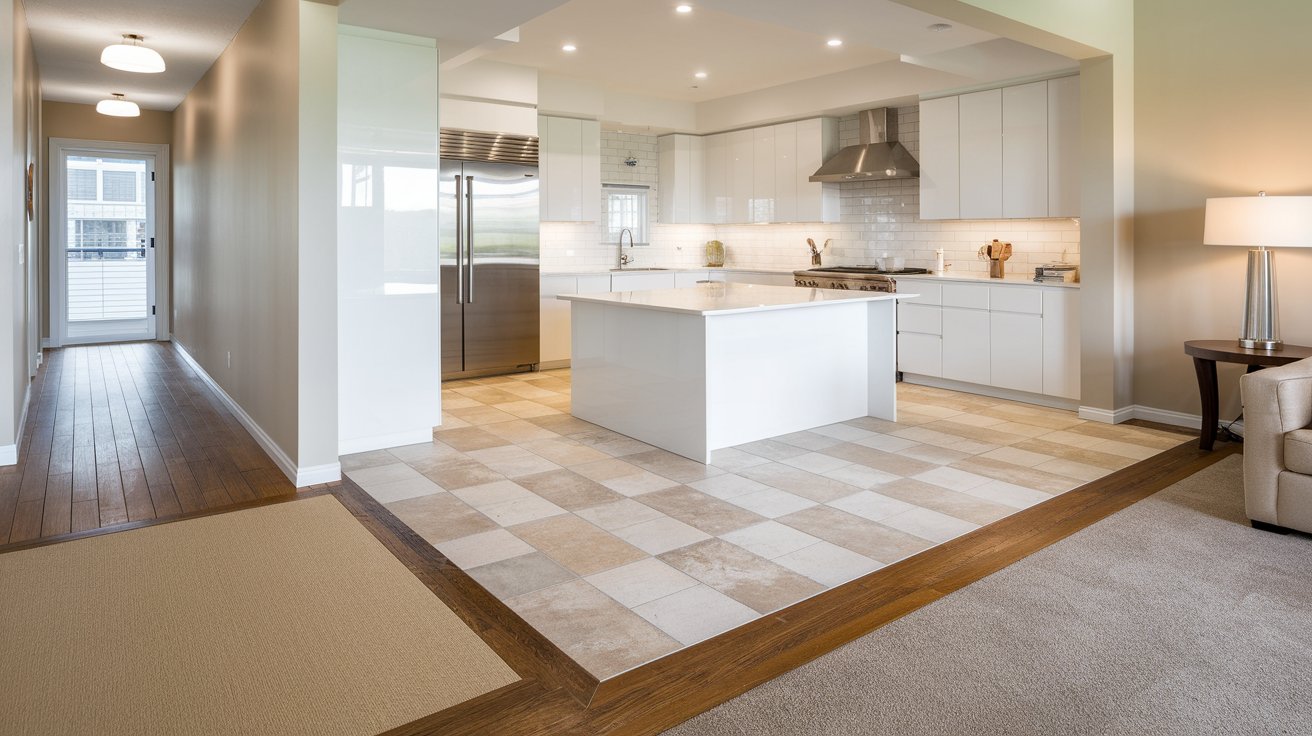
Sophisticated designs employ porcelain tile in the kitchen zone transitioning to engineered hardwood in living areas, using coordinating color tones and plank widths. Contemporary wood-look porcelain tiles perfectly match engineered hardwood species, creating nearly invisible transitions at kitchen boundaries. This combination provides maximum water protection where needed while offering authentic hardwood character in dry living spaces. Transition strips in complementary metal finishes (bronze, brushed nickel) or matching wood species bridge material changes at doorways or natural room divisions. Installation costs increase 25-35% with this approach, but the result delivers tailored performance characteristics optimized for each space’s demands while maintaining design cohesion valued in United States real estate markets.
Should the Kitchen Floor Be Lighter or Darker Than the Countertop?
The relationship between kitchen floor color and countertop finish significantly impacts spatial perception and design harmony. Professional interior designers in 2026 recommend that your floor should be lighter or darker than countertops by at least 2-3 shades to create visual definition and prevent monotonous color schemes.
Lighter flooring paired with darker countertops creates grounded, anchored kitchen designs where cabinetry and work surfaces command visual attention. This combination makes small kitchens appear more spacious by reflecting natural light upward, a technique employed in 64% of contemporary United States kitchen designs under 150 square feet. Conversely, darker floors with lighter countertops establish dramatic contrast suitable for larger kitchens exceeding 200 square feet, where bold design statements enhance rather than overwhelm spaces. Medium-toned floors matching countertop values create cohesive, monochromatic schemes that emphasize texture over color variation, though this approach requires careful attention to prevent flat, uninspiring results. The current trend favors light warm gray or greige flooring with white or light quartz countertops, achieving bright, contemporary aesthetics that photograph well for resale marketing.
Best Flooring for Kitchen Cabinets Coordination
Selecting flooring that complements kitchen cabinets requires understanding undertone harmony and contrast principles. The best flooring for kitchen cabinets either matches wood species and tones for cohesive traditional designs or provides strategic contrast for contemporary aesthetics.
White and light gray cabinets dominate 2026 kitchen trends, comprising 73% of new United States installations. These neutral cabinet finishes pair successfully with virtually any flooring option, though medium-to-dark wood-look vinyl and natural oak hardwood create warmth that prevents sterile appearances. Dark espresso or navy cabinets demand careful flooring selection—light floors prevent cave-like atmospheres while maintaining sophisticated contrast. Natural wood cabinets in oak, maple, or hickory benefit from flooring that either matches the species closely or diverges completely; mid-tone floors resembling but not matching cabinet wood create awkward near-miss aesthetics. Contemporary designs increasingly employ light floors with two-toned cabinetry (white uppers, navy lowers), using flooring as a neutral foundation that allows cabinetry to provide color interest.
Best Flooring for Kitchen Countertop Harmony
Kitchen countertops represent significant investments averaging $3,500-6,000 in United States markets, making flooring selections that enhance rather than compete with countertop materials essential. The best flooring for kitchen countertop coordination follows complementary color theory while considering pattern scale and material authenticity.
Quartz countertops with subtle veining pair beautifully with wood-look vinyl or natural hardwood floors that introduce organic warmth without pattern competition. Dramatic marble or granite countertops featuring bold veining require restrained flooring choices—solid-color luxury vinyl or simple wood grain patterns prevent visual chaos. Butcher block and wood countertops create cozy farmhouse aesthetics when paired with tile flooring in subway patterns or classic hexagon shapes, mixing material types for textural interest. United States kitchen designers recommend limiting prominent patterns to either countertops or flooring, never both simultaneously, to maintain sophisticated visual balance.
Cost Comparison: Kitchen Flooring Investment Analysis
Understanding comprehensive costs helps homeowners make informed decisions balancing initial investment with long-term value. Kitchen flooring costs in United States markets vary substantially based on material selection, installation complexity, and regional labor rates, with total project expenses ranging from $800-8,000 for average 150-square-foot kitchens.
Luxury vinyl flooring offers the most accessible entry point at $3-8 per square foot installed, with DIY projects reducing costs to $2-4 per square foot for materials alone. Porcelain tile installations average $8-15 per square foot including labor, though premium large-format tiles and intricate patterns push costs toward $18-25 per square foot. Engineered hardwood suitable for kitchens ranges $6-12 per square foot installed, while solid hardwood (generally not recommended for kitchens) commands $8-15 per square foot. Natural stone options like slate or travertine reach $12-20 per square foot installed. These figures reflect 2026 United States pricing accounting for 8-12% inflation since 2024. Material longevity dramatically impacts lifetime cost calculations—porcelain tile’s 50-year lifespan costs just $0.16-0.30 per square foot annually, while vinyl’s 20-year expectancy calculates to $0.15-0.40 annually, demonstrating comparable long-term value despite different upfront investments.
Installation Considerations for DIY vs Professional
Installation method selection significantly impacts total project costs and outcome quality. Understanding which kitchen flooring types accommodate DIY installation versus requiring professional expertise helps homeowners budget accurately and achieve satisfactory results.
Luxury vinyl plank with click-lock systems represents the most DIY-friendly option, requiring only basic tools (utility knife, tape measure, spacers) and minimal skill. Manufacturers design these products for floating installation over existing floors, eliminating adhesive mess and allowing immediate use after completion. Confident DIY enthusiasts successfully install 150-square-foot kitchens in 6-10 hours. Conversely, tile flooring demands specialized skills including subfloor preparation, thin-set mortar application, precise cutting, and grouting techniques that significantly impact longevity and appearance. Professional tile installation ensures proper waterproofing, level surfaces, and consistent grout lines that DIY attempts frequently compromise. United States contractors charge $4-8 per square foot for tile labor, representing 50-60% of total project costs. Laminate flooring falls between these extremes—DIY-capable with careful attention but less forgiving than vinyl regarding moisture barriers and acclimation requirements.
Related video about best flooring for kitchen
This video complements the article information with a practical visual demonstration.
What you should know
What is the most waterproof flooring for kitchens in 2026?
The most waterproof flooring options include porcelain tile and luxury vinyl plank with rigid cores (SPC or WPC). Porcelain tile absorbs less than 0.5% water by volume and lasts 50+ years, while 100% waterproof vinyl planks resist standing water indefinitely and cost 40-50% less at $3-8 per square foot installed. Both options protect subfloors from moisture damage and maintain appearance despite spills, leaks, and high humidity. United States building codes increasingly specify these materials for kitchens in flood-prone areas.
How do I choose between vinyl and tile for my kitchen?
Choose vinyl flooring if you prioritize budget flexibility ($3-8 per square foot), cushioned comfort for prolonged standing, DIY installation capability, and immediate usability after installation. Select tile flooring when maximum durability (50+ year lifespan), premium aesthetics, heat resistance near appliances, and highest resale value justify the $8-15 per square foot investment and professional installation requirements. Both materials offer excellent water resistance suitable for kitchen environments. Consider household traffic levels, your budget constraints, and whether you value comfort or ultimate longevity most.
What kitchen flooring color works best for resale value?
Light to medium wood tones in oak, maple, and gray-washed finishes maximize resale appeal across diverse United States buyer preferences. Real estate data from 2026 shows homes with light warm gray or greige kitchen flooring sell 12-18% faster than those with dark or highly patterned floors. Neutral flooring allows buyers to envision their personal style without requiring immediate replacement. Avoid trendy colors like pure white or black that date quickly, and steer clear of orange-toned woods that appear dated. Timeless selections in the $5-9 per square foot range deliver the best return on investment.
How long does luxury vinyl plank flooring last in kitchens?
Quality luxury vinyl plank flooring lasts 15-25 years in residential kitchens under normal use conditions, with commercial-grade products extending beyond 30 years. Lifespan depends on wear layer thickness—12-20 mil wear layers suit light household traffic, while 20-40 mil layers withstand heavy use in large families. Proper installation over level subfloors and routine maintenance with pH-neutral cleaners maximize longevity. Premium brands like CoreTec and LifeProof offer 20-30 year residential warranties. While shorter-lived than porcelain tile’s 50+ year expectancy, vinyl’s lower cost ($3-8 vs $8-15 per square foot) provides comparable lifetime value.
Should kitchen and dining room flooring match?
Kitchen and dining room flooring should match or coordinate closely in open-concept layouts where spaces flow visually together, creating cohesive aesthetics that maximize perceived square footage. Using identical flooring throughout eliminates transition strips that interrupt sight lines and create tripping hazards. In homes with defined room separations via doorways or archways, you can use complementary materials—such as waterproof vinyl in the kitchen transitioning to engineered hardwood in the dining room—connected by coordinated colors and plank widths. This approach optimizes each space’s functional requirements while maintaining design harmony valued in United States real estate markets.
What flooring is easiest to clean in a kitchen?
Luxury vinyl plank and porcelain tile rank as the easiest kitchen flooring to clean, requiring only damp mopping with pH-neutral cleaners for routine maintenance. Vinyl’s smooth, non-porous surface resists staining and never requires sealing, waxing, or refinishing throughout its 15-25 year lifespan. Porcelain tile similarly resists stains and scratches, though grout lines need periodic sealing (every 1-2 years) to prevent discoloration and moisture penetration. Both materials tolerate commercial cleaners without damage. Avoid hardwood and laminate in kitchens due to moisture sensitivity requiring careful cleaning with minimal water. Textured surfaces on slip-resistant products may trap debris but enhance safety—a worthwhile trade-off for households with mobility concerns or arthritis.
| Flooring Type | Cost Per Sq Ft (Installed) | Lifespan | Best For |
|---|---|---|---|
| Porcelain Tile | $8-15 | 50+ years | Maximum durability, waterproof protection, premium aesthetics |
| Luxury Vinyl Plank | $3-8 | 15-25 years | Budget-conscious projects, DIY installation, cushioned comfort |
| Engineered Hardwood | $6-12 | 20-30 years | Kitchen-living room continuity, authentic wood character |
| Natural Stone | $12-20 | 40+ years | Luxury installations, unique aesthetics, heat resistance |
| Water-Resistant Laminate | $2-6 | 10-15 years | Tight budgets, low-moisture kitchens, temporary solutions |